
Michigan Finished Repealing It's Retirement Tax

Updated: 6 days ago

Some of the best financial news arrives quietly. While national headlines focused on Washington, a Michigan law finished doing its work this year. If you're retired (or planning to be), it directly affects how much of your money stays in your pocket.
A quick history lesson. From 2012 through 2022, Michigan taxed most pension and retirement account withdrawals based on the year you were born. Retirees born after 1952 got little or no deduction at all. In 2023, the Lowering MI Costs plan (Public Act 4 of 2023) began rolling that tax back — but it phased in over four years, which is exactly why so many people missed it.
2026 is the year the phase-in is complete. For the first time since 2011, every Michigan retiree (regardless of birth year) can deduct qualifying retirement income up to the full limit.
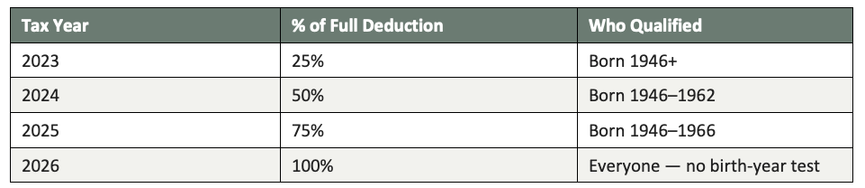
Source: https://www.michigan.gov/taxes/iit/tax-guidance/tax-situations/retirement-and-pension-benefits
What the Full Deduction Is Worth
For 2026, qualifying retirement and pension income is deductible from Michigan taxable income up to:

Compared to 2025, a married couple can shield an additional $36,374 of retirement income from Michigan tax — roughly $1,546 in extra annual savings for those with income at or above the limit. And if you were born after 1966, you were shut out of the phase-in entirely until now.
What Counts as “Qualifying” Income?
Pension payments (private and public)
Withdrawals from 401(k), 403(b), and IRA accounts (most pre-tax employer plan and IRA distributions qualify — rules apply, ask us)
Social Security — trick question! Michigan has never taxed Social Security. Pair that with the new federal senior deduction we covered in November, and many retirees will owe little tax on their benefits at either level.
Public safety retirees: retired police, fire, and state troopers can deduct qualifying retirement income without any dollar cap.
Planning Ideas
Check your withholding
Is your retirement income under $67,610 (single) or $135,220 (joint)? Most or all of it is now deductible, and a big spring refund means you're over-withholding. Above those limits, keep withholding in place. The excess is still taxed at 4.25%.
Revisit your withdrawal order
A larger state deduction can change which account to draw from first — pre-tax, Roth, or taxable (see our March newsletter on taxable accounts).
Rethink the “move for taxes” math
With no state tax on Social Security, a 4.25% flat rate, and now a full retirement deduction, Michigan is more retirement-friendly than many realize.
Coordinate Roth conversions
State treatment of conversions depends on your age and situation. Worth a conversation before year-end if this strategy will be implemented.
As always, if you have any questions, please schedule a time to connect to review your personal situation. A friendly reminder, I'm not a CPA, so please confirm any tax changes with your tax professional. We're glad to coordinate with them directly.
As always, if you have any questions, please schedule a time to connect to review your personal situation. A friendly reminder, I'm not a CPA, so please confirm any tax changes with your tax professional. We're glad to coordinate with them directly.
Alex Potter, CFP®

Michigan Tax Fact
Michigan's income tax started in 1967 at just 2.6%. Today's 4.25% flat rate is actually lower than the 1983 peak of 6.35%.
Securities offered through Registered Representatives of Cambridge Investment Research, Inc., a Broker/Dealer, Member FINRA/SIPC. Investment Advisor Representative, Cambridge Investment Research Advisors, Inc., a Registered Investment Advisor. Cambridge and Foundation Wealth Management are not affiliated. Financial Professionals may only conduct business with residents of the states of jurisdictions in which they are properly registered, licensed or exempt from registration and not all of the securities, products and services mentioned are available in every state or jurisdiction.


Comments